









Are your Amazon products invisible to AI search engines?
While you’re optimizing for traditional SEO, AI engines like ChatGPT, Rufus, and Google’s AI are changing how customers discover products. Traditional tactics like keyword stuffing no longer guarantee visibility, in fact, they may hurt your chances in AI-driven search results.
The game has changed. The sellers who understand Generative Engine Optimization (GEO) and Rufus optimization are seeing better visibility, more traffic, and increased sales.
The numbers tell a stark story: AI Overviews now appear in 13.14% of U.S. desktop queries, and when they do, traditional link clicks drop from 15% to just 8%. ChatGPT processes roughly 2.5 billion prompts daily, while Perplexity handled over 780 million queries in May 2025 alone.
If your products are struggling to get noticed, this guide will walk you through the steps to optimize your Amazon listings for AI search engines, helping you stay ahead of the curve and position your brand where the next generation of shoppers is already searching.
Understanding Generative AI Engines and Their Impact on Search Visibility
What Are Generative Engines?
Generative AI engines represent a fundamental shift in how people search for and discover products online. Unlike traditional search engines that simply rank web pages, generative engines like ChatGPT, Perplexity, Google’s Search Generative Experience (SGE), and Amazon’s Rufus synthesize information from multiple sources to create comprehensive, conversational answers.
When someone asks ChatGPT, “What’s the best wireless gaming headset under $100?” or asks Rufus “Show me durable backpacks for hiking,” these AI systems don’t just show a list of links. They analyze product information, compare features, and provide detailed recommendations based on the query’s intent.
The critical difference? Traditional search engines rank pages based on backlinks, keywords, and domain authority. Generative engines cite sources based on relevance, clarity, factual accuracy, and how well the content answers specific questions. Your product doesn’t need to rank first on Google anymore—it needs to be cited by AI as the best answer.
The Shift from Rankings to Citations
This shift has massive implications for Amazon sellers. In traditional SEO, you competed for position #1 on the search results page. In the AI era, you’re competing to be the source the AI cites and recommends.
Consider these two product titles:
Traditional SEO Title: “Premium Wireless Bluetooth Headphones Over Ear Headset with Mic Microphone Noise Cancelling Gaming Music Travel Work”
AI-Optimized Title: “Sony WH-1000XM5 Wireless Noise-Cancelling Headphones”
The first title might have performed well in 2018. Today, AI systems see it as keyword spam and struggle to extract meaningful information. The second title is clean, clear, and immediately communicates what the product is. AI systems can easily understand and cite this information.
AI Search Visibility Is Earned, Not Bought
Here’s what most Amazon sellers don’t understand yet: you can’t buy your way into generative AI recommendations through ads alone. AI search visibility is earned by providing rich, contextual, and factual information that AI systems can confidently cite and recommend.
When ChatGPT recommends a product, it’s pulling from listings that clearly explain what the product is, who it’s for, what problems it solves, and why it’s better than alternatives. When Rufus suggests items on Amazon, it prioritizes listings with structured data, clear use cases, and buyer intent signals.
Think about how AI makes recommendations. It’s analyzing thousands of products and trying to match them to a specific user need. Your job is to make that matching process as easy as possible by clearly articulating:
What your product is – Clear category and type
Who it’s for – Specific user personas and use cases
What problems it solves – Explicit pain points addressed
Why it’s better – Concrete differentiators with evidence
How it delivers results – Measurable outcomes and benefits
This means your product descriptions, titles, bullet points, and metadata need to speak the language AI systems understand. Vague marketing fluff gets ignored. Clear, evidence-based product information gets cited and recommended.
Thinking About Hiring an Amazon Expert?
Ecomclips’ Partners Achieve an Average 85% Profit Increase!
Let’s Talk
Real-World Impact on Amazon Sales
Let’s look at what this means in practice. Two sellers offer similar yoga mats:
Seller A (Traditional SEO approach):
Title: “Best Yoga Mat Premium Quality Non Slip Exercise Fitness Gym Workout”
Description: “Our amazing yoga mat is perfect for all your fitness needs! Premium quality materials ensure durability. Great for yoga, pilates, and more!”
Seller B (GEO approach):
Title: “LifeForm Yoga Mat – 6mm TPE, Extra Cushioning for Joint Protection”
Description: Designed for practitioners with sensitive knees and joints. The 6mm thickness provides 40% more cushioning than standard 4mm mats, reducing pressure on knees during kneeling poses. Non-slip textured surface maintains grip even during hot yoga sessions up to 105°F. Made from biodegradable TPE material that’s free from PVC, latex, and harmful phthalates.
When a customer asks Rufus or ChatGPT, “What yoga mat is good for people with bad knees?” which product do you think gets recommended?
Seller B’s listing gives AI systems everything they need: specific use case (sensitive joints), measurable benefit (40% more cushioning), technical specifications (6mm TPE), and clear differentiation (biodegradable, chemical-free). Seller A’s listing offers nothing an AI can confidently cite.
This is why GEO matters. It’s not about gaming algorithms, it’s about communicating clearly in a way that serves both AI systems and human customers.
How Generative Engine Optimization (GEO) Can Help Amazon Sellers
What Is GEO and Why Does It Matter for Amazon Sellers
Generative Engine Optimization (GEO) is the practice of structuring your content so generative AI engines can easily understand, interpret, and cite your product information. While traditional SEO focused on keywords and backlinks, GEO focuses on clarity, citations, structured data, and contextual relevance.
For Amazon sellers, GEO means optimizing your product listings not just for Amazon’s A9 algorithm, but for the AI systems that are increasingly influencing purchase decisions. When someone asks ChatGPT for product recommendations or uses Rufus to shop on Amazon, your GEO-optimized listings have a significantly higher chance of being suggested.
Think about it: millions of shoppers now ask AI assistants for buying advice before they even visit Amazon. If your products aren’t optimized for these AI systems, you’re invisible to a rapidly growing segment of buyers who trust AI recommendations more than traditional ads.
Core Metrics to Measure Generative Visibility
Understanding whether your GEO efforts are working requires tracking specific metrics:
- Position-Adjusted Word Count: This measures how much content from your product listing appears in AI-generated responses. When ChatGPT or Rufus cites your product, are they pulling substantial information from your listing, or just a brief mention?
Higher word count in prominent positions indicates stronger AI visibility. For example, if an AI assistant generates a 200-word product recommendation and 80 words come from your listing, you have strong visibility. If only 15 words mention your product in passing, your GEO needs improvement.
Track this by:
Asking AI assistants about products in your category
Noting how often and how extensively they cite your listings
Comparing your citation length to competitors
Monitoring changes over time as you optimize
- Subjective Impression: This evaluates the relevance, uniqueness, and credibility of your product information as perceived by AI systems. Does your listing provide specific, verifiable claims? Does it clearly differentiate your product from competitors?
Assess subjective impression by analyzing:
Whether AI recommendations frame your product positively
If the AI accurately understands your product’s key differentiators
How confidently the AI recommends your product
Whether the AI cites your product for the intended use cases
- Citation Frequency: How often does your product appear in AI-generated recommendations for relevant queries? Test 10-15 different queries related to your product category and track how many times your product gets mentioned.
- Recommendation Quality: When AI systems recommend your product, do they highlight the features and benefits you want emphasized? Or are they pulling irrelevant information because your listing lacks clear structure?
The goal isn’t just to be mentioned—it’s to be prominently featured with detailed information that helps the AI make a confident recommendation to users.
Best Practices for Optimizing Product Listings for AI Search Engines
1. Clarity Over Keyword Stuffing
Remember when cramming every possible keyword into your title seemed like smart SEO? That strategy is not only outdated, it actively hurts your visibility in generative AI search results.
AI engines are trained to understand natural language and context. When they encounter keyword-stuffed gibberish like “Best Premium Quality Wireless Bluetooth Gaming Headset Headphones with Mic Microphone Noise Cancelling,” they struggle to extract meaningful information. Worse, they may interpret this as low-quality content and skip citing your product entirely.
Instead, write titles and descriptions the way you’d explain your product to a knowledgeable friend. “Sony WH-1000XM5 Wireless Noise-Cancelling Headphones” is infinitely more AI-friendly than a keyword soup. Your bullet points should read like natural sentences, not a list of search terms.
Clear, concise, and easy-to-understand product descriptions help AI systems quickly grasp what your product is, what it does, and who should buy it. This clarity translates directly into better AI search visibility.
2. Add Citations, Quotations, and Statistics
One of the most powerful GEO strategies is incorporating authoritative citations, expert quotes, and verifiable statistics into your product descriptions. AI systems are trained to value credible, evidence-based information.
When your listing states, “According to the National Sleep Foundation, adults need 7-9 hours of quality sleep,” AI engines recognize this as reliable information worth citing. When you include “Laboratory-tested to reduce pressure points by 34%” in your mattress description, you’re providing the specific, verifiable data that AI systems prefer.
Expert endorsements work similarly. “Recommended by the American Dental Association for optimal oral health” or “Featured in Consumer Reports as a top-rated air purifier” gives AI systems confidence in recommending your product. These aren’t just marketing claims, they’re signals that your product has third-party validation.
The key is authenticity. Only include citations and statistics you can actually verify. AI systems are increasingly sophisticated at detecting misleading claims, and false information can harm both your AI visibility and your Amazon account health.
3. Using Case-Based Writing for AI-Optimized Product Listings
AI systems excel at understanding cause-and-effect relationships, which makes case-based writing incredibly effective for product descriptions.
The formula is simple but powerful: Feature → Benefit → Result.
Let’s see this in action with a stainless steel water bottle:
Feature: Double-wall vacuum insulation with copper lining. Benefit: Maintains beverage temperature for up to 24 hours. Result: Enjoy ice-cold water during your entire workday or hot coffee throughout your morning commute.
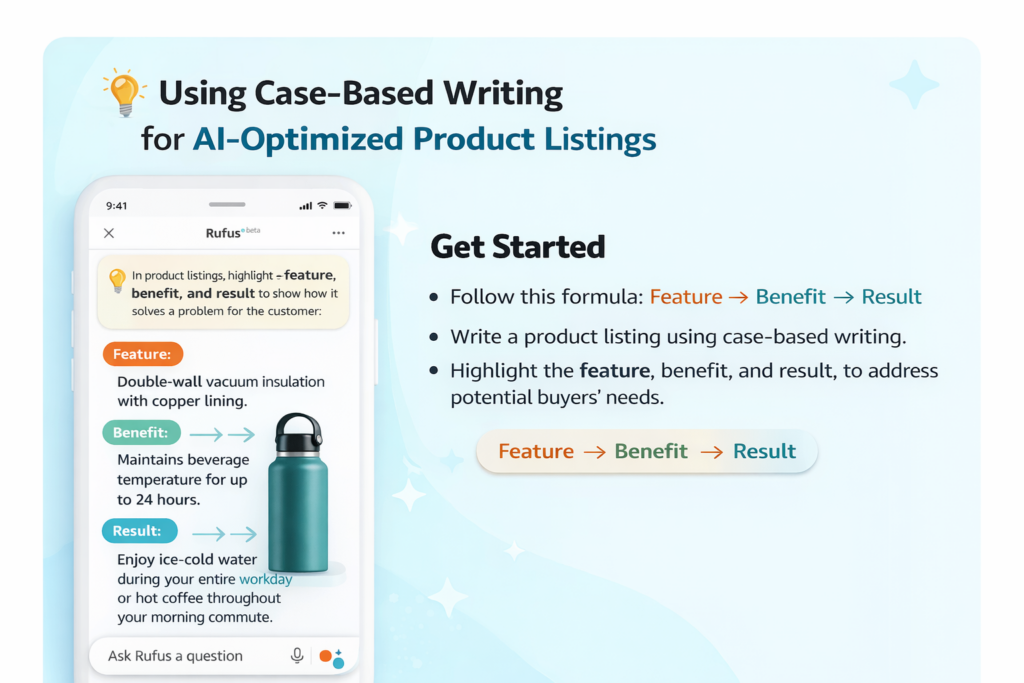
This structure helps AI systems understand not just what your product has, but why it matters and what outcomes customers can expect. When someone asks Rufus “What water bottle keeps drinks cold all day?” your case-based description directly answers that question.
Use Case-Based Writing
Use case-based, structured copy helps AI systems infer fit and relevance, making it easier for them to recommend your product. Structure your descriptions clearly with Feature → Benefit → Result.
- Premium Quality or Durable Construction:
Feature: Crafted from high-quality, durable materials. Benefit: Ensures long-lasting performance and sturdiness. Result: A reliable product that withstands everyday wear and tear.
- Sleek and Modern Design:
Feature: Designed with a contemporary, minimalistic aesthetic. Benefit: Easily complements various home or office styles. Result: Enhances the look of any space with a sophisticated and timeless appeal.
- Gray Laminate Finish:
Feature: Finished with a smooth, stylish gray laminate. Benefit: Offers a refined, professional appearance that resists scratches and stains. Result: A sleek and low-maintenance finish that keeps your product looking pristine.
- Captivating Appearance:
Feature: Features a striking design that catches the eye. Benefit: Adds a visually appealing focal point to any room or workspace. Result: Instantly upgrades the ambiance of your environment, drawing attention with its unique style.
- Easy to Install:
Feature: Comes with all necessary hardware and an easy-to-follow installation guide. Benefit: Can be set up quickly without professional help. Result: A convenient, hassle-free experience, perfect for DIY enthusiasts or busy individuals.
- Organized Storage Solution:
Feature: Designed with multiple compartments for efficient organization. Benefit: Helps you keep your items neatly stored and easily accessible. Result: Creates a tidy and organized space, reducing clutter and increasing productivity.
4. Rufus Optimization: A Key Element for AI Product Discovery
What Is Rufus Optimization and How Does It Affect AI Search?
Rufus is Amazon’s conversational AI shopping assistant that helps customers discover products through natural language queries. Unlike traditional Amazon search, where customers type keywords like “wireless earbuds,” Rufus lets them ask questions like “What are the best wireless earbuds for running in the rain?”
Rufus optimization is the practice of structuring your product information so Amazon’s AI can accurately understand your product’s use case, compare it effectively with alternatives, and determine when it’s the right recommendation for a customer’s specific needs.
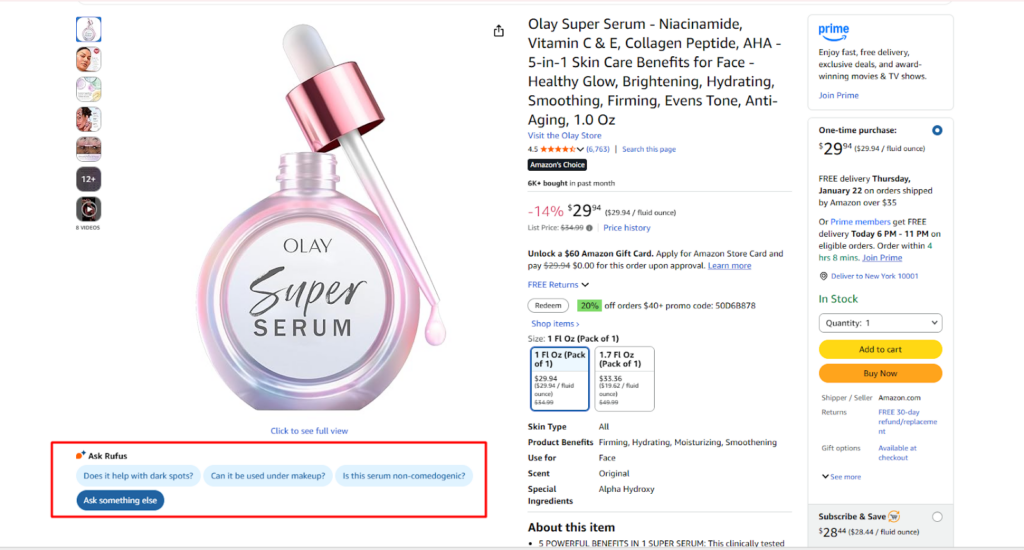
This affects AI product discovery in a fundamental way. When your listing is Rufus-optimized, Amazon’s AI can confidently recommend your product in response to nuanced questions about use cases, comparisons, and purchase readiness. You show up not just for keyword matches, but for intent matches.
Optimizing for Buyer Intent in Amazon Listings
The secret to Rufus optimization is making buyer intent crystal clear in your product descriptions. You need to explicitly address who your product is for, what problems it solves, and how it compares to alternatives.
Start by including scenario-based language in your descriptions:
“Ideal for residential installers who need reliable tools for daily use”, “Perfect for college students living in small dorm rooms”, or “Designed for professional photographers shooting in challenging weather conditions”
These scenarios help Rufus understand context. When a customer asks “What desk lamp is good for reading?” and your description includes “Ideal for extended reading sessions with adjustable color temperature,” Rufus makes the connection.
Comparison language also strengthens Rufus optimization:
“Unlike battery-powered models that lose suction quickly, this corded vacuum maintains consistent power”, or “Compared to traditional foam rollers, our textured design targets deep muscle tissue”
By proactively addressing comparisons and use cases, you’re teaching Amazon’s AI exactly when to recommend your product. This isn’t about gaming the system, it’s about clear communication that serves both the AI and the customer.
5. The Importance of Structured Data for Product Listings
Why Structured Metadata Matters
Structured metadata is the foundation that allows AI engines like ChatGPT and Rufus to correctly interpret and rank your products. Think of metadata as the language AI systems use to categorize, compare, and recommend products.
When your product metadata is properly structured, AI can instantly identify what category your product belongs to, what features it offers, how it compares on price and quality, and which customer needs it addresses. Without structured metadata, even the best product description becomes difficult for AI to process and cite.
Amazon provides specific fields for product information—title, brand, category, bullet points, description, specifications, and more. Many sellers leave fields blank or fill them inconsistently. AI systems notice these gaps and interpret them as incomplete or low-quality listings.
Complete, accurate, and consistently formatted metadata signals to AI engines that your product information is reliable. This reliability increases the likelihood that AI will cite and recommend your products over competitors with incomplete or poorly structured data.
What to Include in Your Product Feeds
Your Amazon product feed should include every available field, filled with accurate, detailed information:
- Product Identifiers: UPC, EAN, ISBN, or ASIN must be accurate and consistent across all platforms. AI systems use these identifiers to cross-reference your product information.
- Pricing Information: Current price, list price, and any sale prices should be up-to-date. AI engines often mention pricing in recommendations, and outdated information undermines credibility.
- Inventory Status: Always maintain accurate stock levels. AI systems may deprioritize products that are frequently out of stock or have long shipping times.
- Media Assets: High-quality images, videos, and lifestyle photos help AI systems understand what your product looks like and how it’s used. Many AI engines now analyze images to verify that visual content matches written descriptions.
- Technical Specifications: Dimensions, weight, materials, power requirements, compatibility information—every technical detail helps AI systems accurately represent your product.
- Category and Browse Nodes: Proper categorization ensures your product appears in relevant AI-generated recommendations for specific product types.
The more complete and accurate your product feed, the more confidence AI engines have in citing and recommending your products. Incomplete feeds mean missed opportunities in AI search results.
Common Mistakes Sellers Make With AI Optimization
Mistake 1: Assuming Traditional SEO Still Works
The biggest mistake is continuing to optimize only for keyword rankings. AI doesn’t care about keyword density, it cares about clarity and relevance.
What fails: Cramming “best wireless earbuds bluetooth 5.0 noise cancelling waterproof sports” into every field
What works: Clear, natural descriptions that explain what the product is and who it’s for
Mistake 2: Neglecting Cross-Platform Consistency
AI systems cross-reference information across platforms. If your Amazon listing says your backpack holds 20L, but your website says 25L, AI systems flag this inconsistency and may avoid citing your product.
Solution: Audit all platforms quarterly:
- Amazon product listings
- Your website product pages
- Social media profiles
- Third-party retailer listings
- Product catalogs and PDFs
Ensure specifications, features, and claims match exactly everywhere.
Mistake 3: Overly Generic Descriptions
“High-quality materials” and “durable construction” tell AI systems nothing. These phrases appear in millions of listings, making them worthless for differentiation.
Generic: “Made from premium materials for lasting durability”
Specific: “Constructed from 600D nylon with reinforced stitching at stress points, tested to withstand 50,000 open/close cycles”
Mistake 4: Ignoring Technical Specifications
Many sellers focus only on marketing copy and neglect the technical specification section. AI systems heavily weight this structured data when making recommendations.
Always complete:
- Exact dimensions (length x width x height)
- Precise weight
- Material composition (with percentages if applicable)
- Power requirements or battery specifications
- Compatibility information
- Certifications and standards met
- Country of manufacture
- Package contents
Mistake 5: Not Testing AI Recommendations
How do you know if your GEO is working if you never test it? Regularly query AI assistants about products in your category and see if yours appear.
Testing protocol:
- Identify 10-15 queries customers might ask about your product type
- Ask ChatGPT, Perplexity, and Rufus these questions monthly
- Document when and how your products are cited
- Note what competitors are being recommended instead
- Adjust your listings based on what’s working for top-recommended products
Mistake 6: Forgetting to Update Listings
GEO isn’t a one-time task. AI algorithms evolve, competitor listings improve, and customer language changes. Sellers who optimize once and never update fall behind.
Update schedule:
- Monthly: Check if your product appears in AI recommendations for key queries
- Quarterly: Refresh statistics, add new citations, update language based on customer questions
- Bi-annually: Complete audit of all metadata fields across all platforms
- Annually: Major refresh incorporating new GEO best practices and algorithm changes
Optimize for AI Search: Future-Proof Your Amazon Sales
The future of product discovery is driven by generative AI, and sellers who adapt to this shift will thrive. While traditional SEO still has a place, AI search visibility requires a new approach—Generative Engine Optimization (GEO) and Rufus optimization. These strategies ensure your products are clearly understood, accurately represented, and recommended by AI systems based on buyer intent.
Start by auditing your listings. Are they clear and natural, with supporting evidence like citations and statistics? Ensure your metadata is complete, and that buyer intent is explicit. Prioritize your best-selling products, and monitor AI-driven recommendations to refine your strategy. The time to optimize for AI is now—those who do will lead the way in tomorrow’s AI-powered shopping experience.
FAQ: Addressing Common Questions
Q. How can I optimize my Amazon listings for AI search engines like ChatGPT?
Focus on clear, natural language descriptions instead of keyword stuffing, and include evidence-based information like citations, statistics, and expert endorsements. Use the Feature-Benefit-Result structure and ensure all metadata fields are complete with scenario-based language that defines who your product is for.
Q. What is Rufus optimization, and how does it affect my sales on Amazon?
Rufus optimization structures your Amazon listings so Amazon’s AI assistant can understand your product’s use case and recommend it for relevant queries. It increases visibility when customers ask natural language questions, helping your products appear in AI-generated recommendations at the exact moment customers need them.
Q. How can I improve my product’s visibility in AI-powered shopping platforms?
Complete every metadata field with accurate, structured information and write clear, evidence-based descriptions that include citations and buyer intent. Maintain consistency across all platforms—Amazon, your website, and social media—so AI systems can confidently cite your product.
Q. Do traditional SEO keywords still matter for AI search optimization?
Yes, but their role has shifted from keyword stuffing to natural incorporation within clear sentences. AI systems understand context and synonyms, so focus on readability and clarity while incorporating keywords naturally.
Q. How often should I update my listings for AI search visibility?
Review and refresh your listings quarterly at minimum, updating statistics, citations, and language based on how customers ask questions. Monitor how AI assistants cite your products and adjust your listings immediately when you notice gaps or inaccuracies.
How eComclips Can Help on the Issue
Optimizing for generative AI engines and Rufus requires expertise in both Amazon’s platform and emerging AI search technologies. eComclips specializes in helping Amazon sellers navigate this transition successfully.
- GEO and Rufus Optimization Strategy: We audit your current listings to identify gaps in AI visibility and create a comprehensive optimization plan. Our team rewrites product descriptions, titles, and bullet points using GEO best practices—incorporating citations, structured case-based writing, and clear buyer intent signals that AI systems recognize and prioritize.
- Structured Metadata Implementation: We ensure every field in your Amazon product feed is complete, accurate, and optimized for AI interpretation. From technical specifications to category assignments, we structure your data so generative engines can confidently cite and recommend your products.
- Cross-Platform AI Compliance: Amazon’s AI scans your listings, website, social media, and other online content for inconsistencies. We audit all platforms to ensure your product information is completely aligned, preventing mismatches that could suppress your AI visibility or trigger account warnings.
- AI-Ready Content Creation: Our team creates clear, natural-language product descriptions that avoid keyword stuffing while incorporating evidence-based claims, expert endorsements, and scenario-based language. We write content that both human customers and AI systems can easily understand and trust.
- Ongoing AI Visibility Monitoring: As AI algorithms evolve, we continuously monitor how generative engines are citing and recommending your products. We provide regular updates and optimizations to maintain and improve your AI search visibility over time.
- Performance Analysis and Reporting: We track key GEO metrics including position-adjusted word count and subjective impression scores, showing you exactly how your AI visibility is improving and which optimizations are driving the best results.
Watch how we help sellers to protect their Amazon Business:
STOP GUESSING! USE AMAZON DATA TO EXPLODE YOUR SALES in 2026
Amazon’s Rufus AI Prompts: The Future of Sponsored Products Optimization
Your Amazon Listing Is Losing Money
Amazon Brand Growth Secrets: Use Customer Data To Boost Sales Fast!
Amazon AI Update 2025: Why Sellers Are Losing Ranking Overnight
Amazon Listing Image Masterclass: How Top Sellers Boost CTR & Conversions
Ecomclips: Your Complete eCommerce Solution Under One Umbrella
At Ecomclips, we bring every eCommerce service you need under one roof — strategy, operations, design, marketing, and growth, all seamlessly connected to help your brand thrive across every marketplace.
Since 2012, we’ve been helping businesses of all sizes launch, scale, and dominate online. From Amazon, Walmart, eBay, and Etsy to Shopify and WooCommerce, our team of marketplace experts, designers, developers, and marketers works together to deliver measurable results.
Our services span the full eCommerce lifecycle:
Account Setup & Product Listing Management: We handle registrations, compliance, and product data optimization across all marketplaces.
Amazon Optimization Service: From keyword-rich titles and A+ content to PPC campaigns and storefront design, we craft listings that convert.
Creative Design & Content Production: A+ visuals, infographics, brand stores, and product videos built to boost engagement.
Advertising & PPC Management: Smart, data-driven ad strategies for Amazon, Walmart, and Google that maximize ROI.
Web Development & Store Design: Shopify, WooCommerce, and Magento websites built for performance and conversion.
Data Management & Automation: Streamlined product feeds, catalog syncing, and inventory control for effortless scalability.
Customer Service & Order Fulfillment: End-to-end support that enhances customer satisfaction and builds long-term loyalty.
Analytics & Growth Strategy: Real-time insights and ongoing optimization to ensure consistent, profitable growth.
Whether you’re launching a new store or managing multiple global marketplaces, Ecomclips acts as your single strategic partner, simplifying complexity and driving sustainable revenue growth.
📝 Website Description
Amazon search is no longer just keywords — it’s powered by AI. With the rise of Rufus AI, Generative Experience Optimization (GEO), and intent-based search, sellers must adapt or risk losing visibility.
In this guide, you’ll learn the secrets of AI-powered Amazon search optimization, how Rufus and GEO influence product discovery, and how to optimize your listings for the future of Amazon in 2026.
Perfect for Amazon FBA, FBM, Private Label, Wholesale, and Brand sellers who want higher rankings, lower ad costs, and sustainable sales growth.
🏷️ Website Tags (Comma Separated)
Amazon AI search, Rufus Amazon AI, GEO optimization, Generative Experience Optimization, Amazon SEO 2026, Amazon ranking factors, AI ecommerce search, Amazon product discovery, Amazon listing optimization, Amazon FBA SEO, Amazon Rufus, AI for Amazon sellers, ecommerce AI optimization, Amazon algorithm update, Amazon voice & AI search


Chat On WhatsApp
📲 Chat On WhatsApp
Please Contact with us for more details.
✅ Our Services Contact Info:
📞 Phone: +8801566058831
💬 WhatsApp: wa.me/8801933307999
🎧 Skype: azadarch
🌐 Website: www.azadservice.com
📢 Telegram: https://t.me/Azadservice
📩 Email: azadarc@gmail.com
🌍 Follow & Connect With Us:
▶️ YouTube Channel:
https://www.youtube.com/@DropshippingService?sub_confirmation=1
👨💻 Virtual Assistant Services:
www.azadservice.com/category/virtual-assistant/
👥 Facebook Group:
https://www.facebook.com/groups/854505676275341/
📘 Facebook Page:
https://www.facebook.com/independentservice.today
💼 LinkedIn:
https://www.linkedin.com/in/azadservice/
📸 Instagram:
https://www.instagram.com/azadservicebd/
📌 Pinterest:
https://www.pinterest.com/aza
✅ Optimized YouTube Description (All Videos)
Below is your final polished version:
🔥 Watch Our Best E-Commerce Tutorials & Professional Service Guides
Grow your Amazon, Walmart, Shopify, TikTok, and eBay business with expert strategies, step-by-step tutorials, and high-ROI services.
✅ Most Popular Videos
🔹 Remove Infringing Sellers — Protect Your Trademark
https://www.youtube.com/watch?v=GRSBPMQryhc&list=PLhwkTM6gFzyqU97M5cDqqbEuuiKg3eMC2
🔹 Amazon FBA Private Label Product Research — Find Winning Products 🚀
https://www.youtube.com/watch?v=GRSBPMQryhc&list=PLhwkTM6gFzyqU97M5cDqqbEuuiKg3eMC2
🔹 Walmart Store Setup & Management — Grow Your Walmart Business
https://www.youtube.com/watch?v=GRSBPMQryhc&list=PLhwkTM6gFzyqU97M5cDqqbEuuiKg3eMC2
🔹 How to Generate UPC Codes (Non-GS1) for Amazon, eBay, Shopify
https://www.youtube.com/watch?v=GRSBPMQryhc&list=PLhwkTM6gFzyqU97M5cDqqbEuuiKg3eMC2
🔹 Brand Name Approval on Amazon WITHOUT Brand Registry
https://www.youtube.com/watch?v=GRSBPMQryhc&list=PLhwkTM6gFzyqU97M5cDqqbEuuiKg3eMC2
🔹 $10K Investment Strategies Revealed by Financial Analyst
https://www.youtube.com/watch?v=GRSBPMQryhc&list=PLhwkTM6gFzyqU97M5cDqqbEuuiKg3eMC2
🔹 Amazon Transparency Program Setup — Protect Your Account
https://www.youtube.com/watch?v=GRSBPMQryhc&list=PLhwkTM6gFzyqU97M5cDqqbEuuiKg3eMC2
🔹 Manage Amazon PPC Campaigns Like a Pro 🚀
https://www.youtube.com/watch?v=GRSBPMQryhc&list=PLhwkTM6gFzyqU97M5cDqqbEuuiKg3eMC2
🔹 Expert VA for Amazon, eBay, Walmart, TikTok & Shopify
https://www.youtube.com/watch?v=GRSBPMQryhc&list=PLhwkTM6gFzyqU97M5cDqqbEuuiKg3eMC2
🔹 TikTok Shop Owners — STOP This Big Mistake
https://www.youtube.com/watch?v=GRSBPMQryhc&list=PLhwkTM6gFzyqU97M5cDqqbEuuiKg3eMC2
🔹 Complete eBay Selling Guide for Beginners (2025)
https://www.youtube.com/watch?v=GRSBPMQryhc&list=PLhwkTM6gFzyqU97M5cDqqbEuuiKg3eMC2
🔹 Sell Products Online on Amazon Saudi Arabia
https://www.youtube.com/watch?v=GRSBPMQryhc&list=PLhwkTM6gFzyqU97M5cDqqbEuuiKg3eMC2
🔹 Start a Shopify Dropshipping Store (Bangladesh Guide)
https://www.youtube.com/watch?v=GRSBPMQryhc&list=PLhwkTM6gFzyqU97M5cDqqbEuuiKg3eMC2
🔹 How to Collect Creative T-Shirt Design Concepts 🎨
https://www.youtube.com/watch?v=GRSBPMQryhc&list=PLhwkTM6gFzyqU97M5cDqqbEuuiKg3eMC2
🔹 Fix Amazon Seller Account Health 🚨 (Suspension Appeal)
https://www.youtube.com/watch?v=GRSBPMQryhc&list=PLhwkTM6gFzyqU97M5cDqqbEuuiKg3eMC2
🕌 Motivational Note
Before starting your work, always pray.
If you have prayed, Alhamdulillah. If not, please pray first — it brings barakah to your day.
📲 Chat With Us on WhatsApp (24/7 Support)
👉 wa.me/8801933307999
📞 Contact Information
✔ Phone: +8801566058831
✔ WhatsApp: wa.me/8801933307999
✔ Skype: azadarch
✔ Website: www.azadservice.com
✔ Telegram: https://t.me/Azadservice
✔ Email: azadarc@gmail.com
🌍 Follow & Connect With Us
▶ YouTube Channel:
https://www.youtube.com/@DropshippingService?sub_confirmation=1
👨💻 Virtual Assistant Services:
www.azadservice.com/category/virtual-assistant/
👥 Facebook Group:
https://www.facebook.com/groups/854505676275341/
📘 Facebook Page:
https://www.facebook.com/independentservice.today
💼 LinkedIn:
https://www.linkedin.com/in/azadservice/
📸 Instagram:
https://www.instagram.com/azadservicebd/
📌 Pinterest:
https://www.pinterest.com/aza











+ There are no comments
Add yours